Love, Valentine's and weddings
Two different buyers come to this material and they want nearly opposite things. One is selling an object against a deadline — a gift, a dinner, a ring — and needs a frame that reads as romance in half a second with room left for a price. The other is selling a service to someone planning the largest event of their life, and needs a frame that looks like a real wedding rather than a set. Choosing from the wrong half is the most common reason a licensed frame dies at the layout stage.
Two calendars, not one
Valentine's retail is a single-day peak assembled in December and January. US spending is forecast at $29.1 billion in 2026, an average of $199.78 a person, with 55% of consumers celebrating — and inside that, jewellery at $7 billion, an evening out at $6.3 billion and flowers at $3.1 billion are three unrelated briefs sharing one date. The flower share overlaps flowers and floral as much as it does this collection. Jewellers run earlier still, because proposals arrive before the campaigns do: close to 40% of engagements fall between November and February, December alone carrying 19%, with Christmas Day the single most popular day to propose.
The wedding trade works to a slower clock. Couples plan for about 14 months on average, and 76% marry between May and October, so a venue, planner or florist is marketing hardest in winter and early spring — to people who got engaged at Christmas and are booking for next autumn. A frame licensed for that audience has to still be in rotation eight months later.
The retail frame and the supplier frame
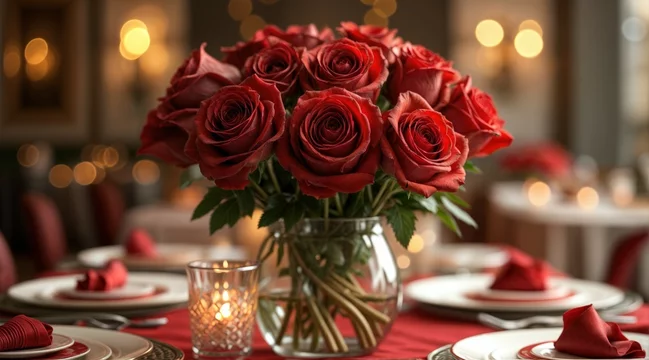
A retail frame is tight, graphic and unembarrassed: saturated colour, heart shapes, a gifting gesture, clean space for a price or a code. It is allowed to be stylised, because nobody mistakes it for documentary.
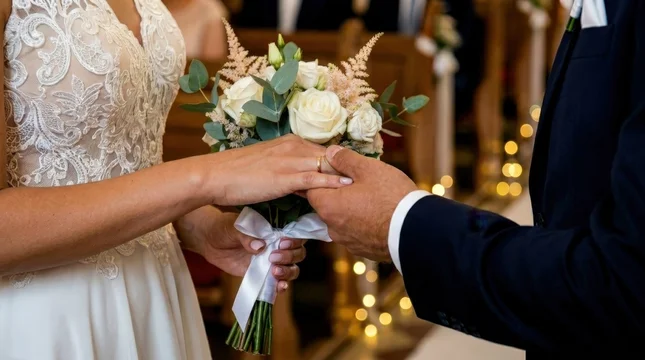
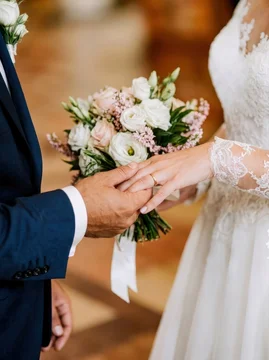
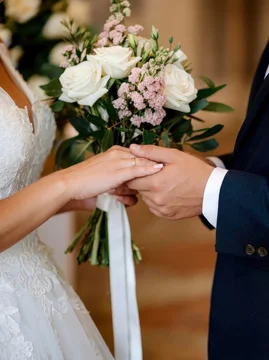
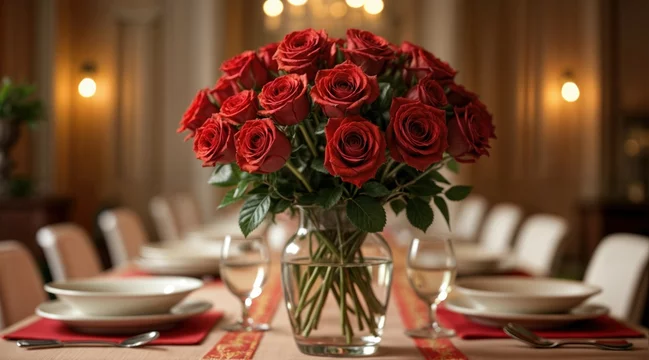
A supplier frame is judged against the real thing. The same study puts the average US wedding at $34,000 with 117 guests, and 88% of couples hiring a professional photographer: that audience has spent a year looking at wedding photography and spots a styled set immediately. What survives the comparison is the unglamorous specifics — a table mid-service rather than before it, a dress detail at working distance, hands and rings, a venue with its doors open and nobody posed in them.
Where the library runs out
Almost a quarter of weddings fall outside that May-to-October window and barely anyone shoots them. Couples over fifty, second marriages and small civil ceremonies are under-served to the point a supplier marketing to them has nothing to choose from. So is the administrative middle — the planner's table, the seating chart, the fitting, the paperwork — which is what a service provider actually sells.
- Decide first which buyer the frame serves: a gift being bought, or a service being chosen.
- Check whether anything in frame pins it to 14 February — hearts, red, a card — if the campaign runs longer.
- Prefer detail frames with no identifiable face when you have no model release to rely on.
- Look at the ring and the dress silhouette: both date a frame faster than the grade.
- Confirm the composition survives a 9:16 crop, since supplier marketing is mostly vertical.
- Confirm the flowers in frame are plausible for the month the campaign runs in.
If the brief is really about atmosphere rather than the event — something slow and quiet under a voiceover — calm and serene will serve it better.


























 00:40
 00:39
 00:40
 00:35
 00:40
 00:40
 00:40
 00:40
 00:40
 00:40
 00:40
 00:40
 00:40
 00:40
 00:40
 00:40













































Need a shot that isn't here? Write to me.
Get in touchMore collections
See all 1,185
Textures and surfaces
Marble, stone, plaster, fabric and metal surfaces for backgrounds, overlays and product scenes.
 1,093
Abstract backgrounds and animations
Gradients, kaleidoscopes, particles and fluid motion for backgrounds and transitions.
 721
Food and drink
Coffee, tea, desserts and table scenes for food and hospitality.